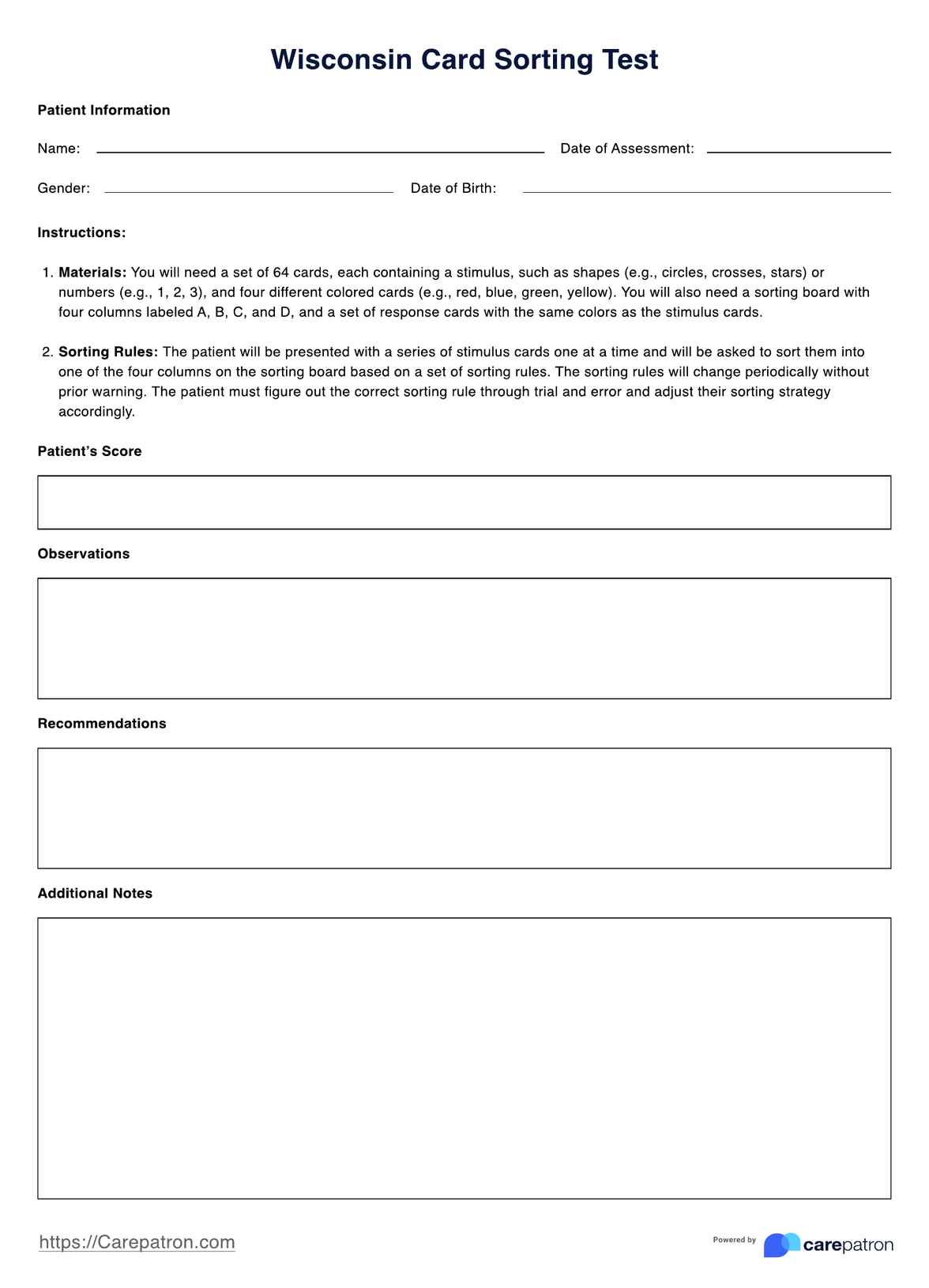




What is a Wisconsin Card Sorting?
The (WCST) is a psychological examination commonly employed to evaluate executive function, cognitive flexibility, and problem-solving skills. It was initially created by psychologists at the University of Wisconsin in the 1940s, and it has since grown to be one of the most popular neuropsychological tests.
During the test, participants are given cards with one of four printed abstract symbols. The cards are distinct in terms of color, shape, and quantity. Following an implied sorting rule, the player arranges the cards into several piles. The participant must learn the new rule through trial and error as the sorting rule evolves.
The test aims to gauge the participant's flexibility in switching focus between tasks and their capacity to adjust to changing rules. Additionally, it estimates how well they can control previously ingrained responses and take in input.
The Wisconsin Card Sorting Test has been used in various settings, such as clinical psychology, neuropsychology, and academic study. It is frequently used to evaluate people who have neurological problems, brain traumas, and psychiatric conditions like schizophrenia and autism. The test is also employed in academic research on the neural and cognitive processes that underlie cognitive flexibility and problem-solving skills.