## **What is a Yocum Test?**
The Yocum Test, also known as the Yocum Maneuver, is a physical assessment done by practitioners specializing in shoulder and elbow pain, such as an orthopedic specialist or physical therapist, to check if a patient has subacromial impingement syndrome.
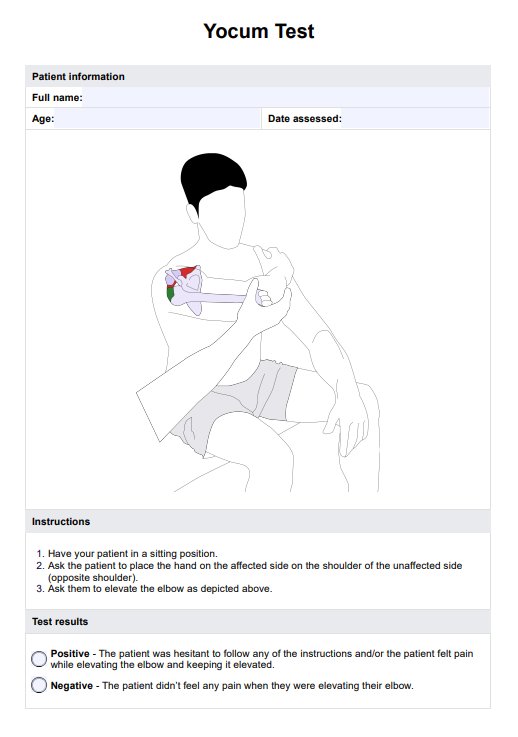
To check if the patient has an impingement in the shoulder rotator cuff, the patient will be asked to adduct the arm of the affected side, flex the elbow of said arm, and place their hand on the opposite shoulder. Afterward, without moving their shoulder, they will be asked to raise their elbow. A positive result is when it's obvious that the patient is hesitating to do the test or when they experience pain.
Please note that this is for subacromial impingement syndrome (sometimes called rotator cuff impingement). It's easy to use the terms subacromial impingement syndrome and subacromial pain syndrome interchangeably. The former is a specific type of compression that causes pain, while the latter refers to pain in the subacromial area in general (so the shoulder pain is not limited to impingement).
The Yocum test “as the best sensitivity and accuracy compared to other physical examination maneuvers that are used to detect subacromial impingement on a patient's shoulder (Silva et al., 2008).
If you're looking for other relevant resources, feel free to watch this video:
## **How does it work?**
Here's how you can get started with the Yocum Test:
### **Step 1: Access the template**
To access and download the template, you can do either of the following:
- Click the “Download Template” or “Use this Template” button in this guide.
- Search for the “Yocum Test” in Carepatron's Template library on our app or website.
### **Step 2: Conduct the test**
After you complete the required basic information, such as your name, the patient's name, and the exam date, you may conduct the test.
Though you have a copy of the instructions on the template, to help you prepare as early as now, we've provided the same directions below:
1. Have your patient in a sitting position.
1. Ask the patient to place their hand on the affected side on the shoulder of the unaffected side (opposite shoulder).
1. After the patient places their hand on the unaffected side, ask them to elevate the elbow.
### **Step 3: Interpret the results**
Once you're finished conducting the test, you can record the patient's results and any additional findings you may have.
Below, you'll find the interpretation you'll also find on the template:
- **(+) Positive test if**: The patient is hesitant to follow any of the instructions, and/or the patient feels pain in the affected shoulder when the patient actively raises their elbow and keeps it elevated.
- **(-) Negative test if**: The patient didn't feel pain at all while raising their elbow and keeping it elevated.
### **Step 4: Proceed with further testing**
To ensure the diagnosis is accurate, aside from the test, it's recommended that the practitioner also ask the patient to undergo further testing such as MRI scans, ultrasounds, CT scans, and X-rays.
## **When would you use this template?**
Practitioners, specifically orthopedic specialists and physical therapists, may use this Yocum Test template when their patients exhibit (contralateral) shoulder impingement or rotator cuff tendinitis symptoms.
To help you out, we've listed down the common symptoms of this condition are:
- Pain and tenderness from the front of your shoulder to the side of your arm
- Pain in the area when moving or at rest
- Pain with lifting and reaching
- Pain when arms are raised or overhead
- Pain when lying on the affected side
- Pain or an ache at night
- Pain when reaching for something behind your back
- Weakness or stiffness behind your shoulder and/or arm
It'll also be beneficial to conduct this test on patients who are athletes of sports that have overhead movements often whenever they complain of pain in the shoulder area.
## **Benefits of using the Yocum's test template**
Here are the advantages you can get when incorporating this template into your practice:
### **Easy to understand**
The instructions on our Yocum Test template are written in layman's terms, making them easy to understand and follow. Furthermore, the template is short and organized, considering the flow from gathering information to writing test results. This intuitive design was intended to make it more efficient for anyone to conduct the test.
### **Quick to administer**
Because the test is short, you only need a few minutes to do it, and you'll be saving up more time by having a template, like ours, that comes complete with instructions and an interpretation guide.
### **Written copies for reference**
With a template like ours, you will now have written copies you can use as a reference to avoid the risk of forgetting results. And if you save and store your completed document on Carepatron, other relevant practitioners will have written copies for reference once you provide them with limited viewing access.
### **Insight into the patient's condition**
You may use this test as a basis or jumping-off point for discussing the patient's health and daily routine, especially if they test positive.**Benefits of using the Yocum's test template
## **References**
Silva, L., Andreu, J. L., Munoz, P., Pastrana, M., Millan, I., Sanz, J., Barbadillo, C., & Fernandez-Castro, M. (2008). Accuracy of physical examination in subacromial impingement syndrome. Lara D. Veeken, 47(5), 679–683. https://doi.org/10.1093/rheumatology/ken101
References
L. Silva and others, Accuracy of physical examination in subacromial impingement syndrome, Rheumatology, Volume 47, Issue 5, May 2008, Pages 679–683, https://doi.org/10.1093/rheumatology/ken101